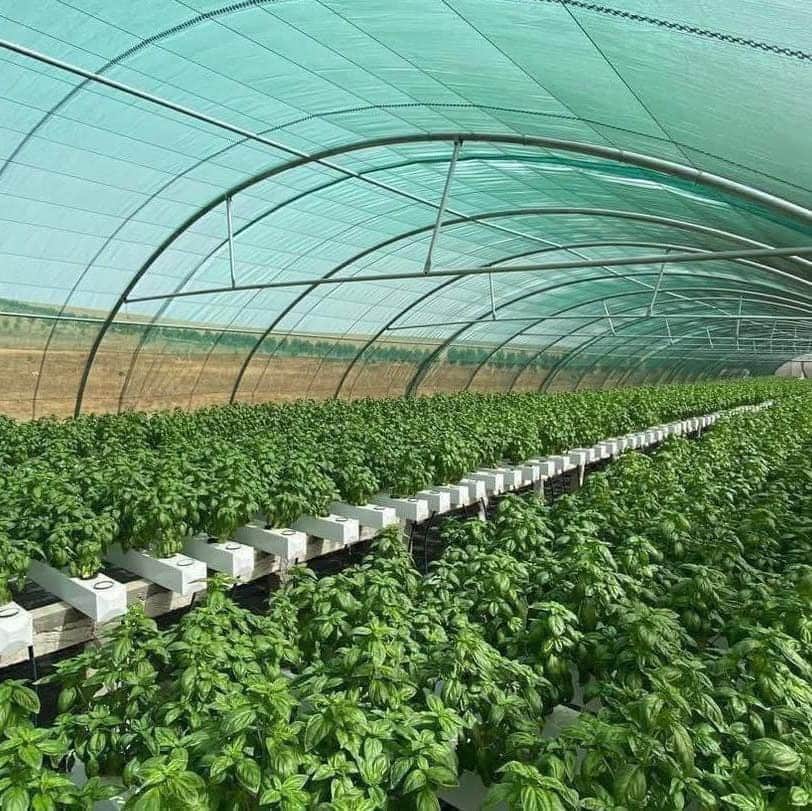
Hydroponic greenhouse
4,130 basil plants, production at scale.
Production at scale: 4,130 plants on 500 m², 7,250 kg per year and an estimated net profit of 50,088 DT.
- basil plants
- 4,130basil plants
- of production / year
- 7,250 kgof production / year
- estimated net profit / year
- 50,088.4 DTestimated net profit / year
How the greenhouse works
Growing is soil-less, in the NFT system: the roots bathe in a film of nutrient solution circulating in a closed loop.
Profitability
Based on a basil crop with a guaranteed buy-back at 8 DT/kg.
In the first year, the costs of technical monitoring, plant replacement between cycles and the nutrient solution are covered by La Ferme Urbaine. From the second year, a monthly fee of 500 DT applies to cover these services.
- Agronomic follow-up6,000 DT
- Electricity1,911.6 DT
Estimate based on production data provided by La Ferme Urbaine for a basil crop, with a guaranteed buy-back. Actual results depend on crop management.
What's included
A greenhouse delivered ready to produce.
Structure
Farming greenhouse sized for your surface area, designed for hydroponic growing.
NFT system
Growing channels using the nutrient film technique, installed and calibrated.
Hydraulic circuit
Pump, tank and circulation of the nutrient solution, ready to run.
Assembly and electrical work
Complete assembly of the greenhouse and electrical installation on site.
Transport
Delivery of all the equipment to your land.
Training
Initial training in crop management, included on delivery.
AIPIA subsidy
Up to −55% off your investment.
The Agence de Promotion des Investissements Agricoles (AIPIA) subsidises innovative agriculture projects in Tunisia, including hydroponics. We build the application with you — from the feasibility study to filing — to maximise the share covered.
We support you in preparing the AIPIA application once the project is confirmed.
Payment of the subsidy can take 1 to 2 years after the application is filed.
Programme applicable in Tunisia only.
After delivery
You're not left on your own: initial training, monthly sessions and five years of agronomic follow-up.
- 1
Initial training
On delivery, getting to grips with the greenhouse and the NFT system.
- 2
Monthly sessions
Monthly appointments to fine-tune crop management.
- 3
Agronomic follow-up
Support on the nutrient solution, pruning and maintenance.
- 4
3-year contract
Contractual support over five years, renewed automatically by tacit renewal, from start-up to stable production.
500 m² NFT hydroponic greenhouse
The 500 m² model is for those who want to step up to larger-scale production, with stronger profitability while keeping a human-sized operation.
Who is the 500 m² greenhouse for?
Do you already have farming experience, or are you aiming straight for an ambitious project? The 500 m² model gives you significantly higher production capacity, suited to regular sales and steady volumes.
This surface suits operations that want to generate a main income, cooperatives and investors seeking a modern, lasting agricultural activity. It calls for slightly more structured organisation, yet remains perfectly manageable with a small team.
It is the format that combines calm management with economies of scale: the more you produce, the more your fixed charges dilute and the better your margin. At this scale, every improvement in your management translates directly into a profitability gain.
The NFT system at 500 m² scale
The principle is still the Nutrient Film Technique: a nutrient film circulates continuously in contact with the roots, for fast growth and consistent quality. On 500 m², the number of growing lines increases, and the hydraulic circuit is sized accordingly.
Water is recycled in a closed loop, which keeps consumption very low despite the larger surface. In the Tunisian climate, this water efficiency is a major economic and environmental advantage. You thus produce large volumes while preserving the resource, a rare balance in intensive farming.
Management stays ergonomic: standing work, no weeding, impeccable hygiene. Enlarging the surface does not complicate the daily gesture, it multiplies it.
Confirmed figures for basil
Here again, basil is the flagship crop, with a guaranteed buyback at 8 DT/kg. The confirmed figures for the 500 m² model are as follows.
The price of this model is set on quote, according to your land and the chosen configuration. Contact us for a personalised study and a precise estimate. Feel free to send us the characteristics of your land to speed up the study.
As with all our models, the public AIPIA subsidy can reach up to 55 %, which considerably eases your initial investment.
- 4130 basil plants installed
- about 5000 kg of basil per year
- 58 000 DT in annual revenue
- 7 911,6 DT in operating charges per year
- about 50 088 DT in net profit per year
- turnkey price: on quote
Turnkey and three-year support
The turnkey scope is identical to that of our other models: steel structure, NFT system, hydraulic circuit, electrical installation, transport, on-site assembly and initial training. You start with an operational business.
You then enjoy initial training, monthly sessions and a three-year agronomic follow-up framed by a service contract. Our agronomists help you hold your volumes, secure quality and maximise your net profit. This regular presence often makes the difference between a good season and an exceptional one.
Finally, we support you with your AIPIA subsidy application, turning an ambitious project into a financially solid reality.
Frequently asked questions
What is the price of this hydroponic greenhouse?
Our greenhouses are quoted on request, based on size and your project. The AIPIA subsidy can reduce the investment by up to −55% in Tunisia.
What does the turnkey price include?
The structure, the NFT system, the hydraulic circuit, assembly and electrical installation, transport and initial training. A greenhouse ready to produce.
How long does it take to install the greenhouse?
Once the project and application are validated, the turnkey installation is carried out by our teams. The precise schedule is confirmed in your quote.
Are training and follow-up included?
Yes: initial training on delivery, monthly sessions and agronomic follow-up as part of a three-year contract.
What profitability can I expect?
On a basil crop with a guaranteed buy-back at 8 DT/kg, the estimated profitability is detailed in the ledger on this page. It depends on the size and on crop management.
How does the AIPIA subsidy work?
AIPIA subsidises innovative farming projects by up to −55% in Tunisia. We build the application with you, from study to submission. Payment of the subsidy can take 1 to 2 years after the application is filed.
What daily maintenance is involved?
Three main tasks: balancing the nutrient solution, pruning the plants and maintaining the circuit. They're learned during the training, on your own greenhouse.
Do I need good land to install the greenhouse?
Hydroponics frees you from soil quality. What matters most is a location, access to water and electricity — land unsuitable for conventional farming can work.
Can I change crops later?
The NFT system suits leafy and aromatic crops. We advise you on the crops suited to your greenhouse and your market.
What happens in a power cut?
A well-sized system tolerates short interruptions. Our recent installations include a solar power supply for greater autonomy.
How do I get a quote for this model?
Click "Request a free quote": we'll get back within 48h with an estimate of cost, production and profitability for your project.
Ready to launch your project?
We'll get back to you within 48h with a first estimate and the subsidy application.